179 Prom. du Portage, 4th floor, Gatineau, QC J8X 4B7, Canada


30 Sep
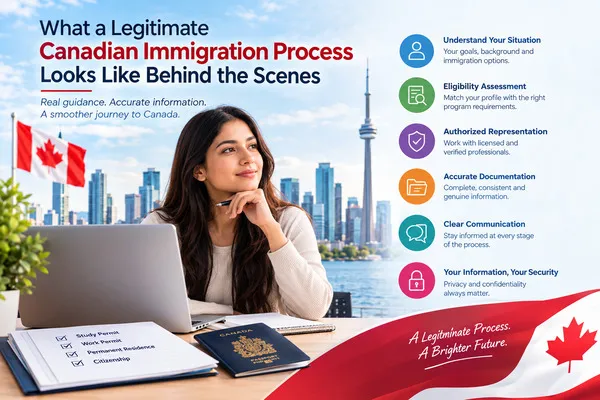
For many applicants, the Canadian immigration process may appear straightforward from the outside. In reality, a legitimate immigration application involves careful assessment, accurate documentation, regulatory compliance, and ongoing communication. Charterlane Immigration believes that understanding what happens behind the scenes can help applicants make informed decisions and recognize the difference between responsible immigration support and unrealistic promises.
Whether someone is applying for a visitor visa, study permit, work permit, permanent residence, or citizenship, knowing how the process works can provide greater clarity and confidence.
A legitimate immigration process does not begin with a guarantee of approval. It begins with understanding the applicant.
Depending on the immigration pathway, relevant factors may include education, work experience, language ability, financial circumstances, family situation, previous immigration history, and the applicant's purpose for coming to Canada.
Every application is different. A pathway suitable for one person may not be appropriate for another. That is why a responsible process starts by reviewing the applicant's circumstances before determining which options may be relevant.
Before an application is prepared, the requirements of the selected immigration program should be reviewed against the applicant's situation.
This can involve examining eligibility criteria, documentation requirements, language results, employment history, education, financial information, and other program-specific factors.
A proper assessment should identify both strengths and potential concerns. The purpose is not to promise a particular outcome, but to help the applicant understand whether they may qualify and what preparation may be necessary.
Applicants who choose to hire a paid immigration representative should verify that the individual is authorized to provide immigration services.
Depending on their profession, authorized representatives may include Canadian lawyers or paralegals regulated by a law society, Quebec notaries, or immigration and citizenship consultants who are members in good standing of the College of Immigration and Citizenship Consultants (CICC).
Applicants can also use the CICC public register to verify a consultant's professional status. This simple verification step can help applicants avoid unauthorized individuals who may offer immigration services without the required authorization.
A significant amount of work happens before an application is submitted.
Forms and supporting documents need to accurately represent the applicant's circumstances. Depending on the program, documentation may relate to identity, education, employment, finances, family relationships, travel history, or other eligibility factors.
A responsible preparation process also involves checking information for consistency. Differences between forms and supporting documents, missing information, unexplained gaps, or incorrect dates can create unnecessary complications.
The objective should never be to create a stronger-looking story. It should be to present the applicant's real circumstances clearly and accurately.
One of the clearest signs of a legitimate process is the absence of unrealistic promises.
Using a representative does not give an application special attention or guarantee approval. Canadian immigration authorities make decisions on applications based on the applicable laws, regulations, program requirements, and information provided.
Applicants should therefore be cautious of anyone claiming they can guarantee a visa, permanent residence, citizenship, employment, or faster government processing.
Professional assistance is about preparing and presenting an application properly—not controlling the final decision.
Even when an authorized representative helps prepare an application, the applicant remains responsible for the information submitted.
Applicants should review important information, provide genuine documents, disclose relevant facts, and ask questions whenever something is unclear.
False or misleading information can have serious consequences, including application refusal and other immigration consequences. Providing inaccurate information simply to make an application appear stronger can create significantly greater problems later.
Submitting an application is not always the end of the process.
Depending on the application, additional requirements may arise, including requests for documents, biometrics, medical examinations, interviews, or other information.
A professional process should involve clear communication about what is happening and what action the applicant needs to take.
Applicants should also receive copies of important documents and maintain their own records throughout the process. Keeping copies of applications, supporting documents, correspondence, and payment records can make it easier to track the progress of an immigration matter.
Applicants should understand exactly what professional services they are paying for.
A written agreement should clearly explain the services included and the professional fees involved. Government processing fees and other third-party expenses should also be understood separately.
Clear financial information helps prevent misunderstandings and gives applicants a better understanding of their overall immigration expenses.
Immigration applications can contain highly sensitive personal information, including passports, financial records, employment documents, education records, and family details.
Applicants should understand who has access to their information and how their documents are being handled.
Responsible immigration support should treat client information with appropriate confidentiality and care. Good information-handling practices are an important part of maintaining trust throughout the immigration process.
Before choosing an immigration representative, applicants can take several practical steps:
Applicants should be particularly cautious of representatives who encourage false information, promise guaranteed outcomes, or claim they can provide special or faster processing.
A legitimate Canadian immigration process is built around facts, accurate information, proper documentation, authorized representation, and realistic expectations.
The work behind a professional immigration application is not about finding shortcuts. It is about understanding the applicable requirements, identifying the appropriate pathway, preparing information carefully, and communicating clearly throughout the process.
Immigration programs and requirements can change over time, which makes it important for applicants to rely on current and trustworthy information when making decisions about their future.
For applicants, the most important step is to remain informed. Ask questions, verify credentials, understand what is being submitted, and never allow anyone to pressure you into providing inaccurate information.
If you are considering professional guidance for your Canadian immigration journey and want to understand your options, contact charterlane immigration for more information and guidance based on your individual circumstances.